BONES OF WARHORSE WILL BE INTERRED NEAR JACKSON
By Martha Boltz
Special to theWashington Times
Saturday, July 19, 1997; Page B3
©The Washington Times. All rights reserved.
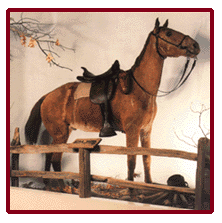
Little Sorrel was a redoubtable gelding that was the favorite mount of one of the Confederacy's revered generals, Thomas J. "Stonewall" Jackson, and reliably carried Jackson over long miles of battle marches. Stonewall was riding Little Sorrel when he was fatally wounded at Chancellorsville.
A granite marker will be dedicated to the warhorse tomorrow on the parade ground at the Virginia Military Institute in Lexington, Va., when the bones of the small brown horse finally will be interred, at the urging of the United Daughters of the Confederacy (UDC). However, the horse's hide, mounted on a plaster frame, will remain on display at VMI.
Little Sorrel was a Morgan horse, descended from the original "Justin Morgan horse" born in 1789 in Springfield, Mass. The breed is smaller than the traditional thoroughbred, with a stocky, cobby body; long, thick mane and tail; and sturdy legs, resulting in fewer of the leg and foot problems that plague their more graceful-appearing brethren. Known for being "up headed" and aware of their surroundings, the Morgans also have an ability to remain calm under fire, which made them practical mounts for cavalrymen.
Morgans are known as "easy keepers," subsisting on a handful of grain, while most horses require several quarts. They became the horse of choice for the U.S. Cavalry, and Southern cavalrymen moved quickly to add the speed-endowed horses to their ranks whenever possible, by whatever means available. After the war, this sturdy breed would carry settlers west and find new roles as superior cow-cutting horses. The predominant Morgan color is chestnut, or sorrel, even today.
The exact provenance of Little Sorrel, who was acqired from the Yankees, appears lost to historians more concerned with the rider than with the horse. It is known that around April 28, 1861, Jackson arrived in Harpers Ferry nine days after Union troops had set fire to the armory and arsenal. A few days later, Confederates seized a Union train. Four cars were loaded with beef cattle, and the fifth contained horses. Jackson had no personal mount at the time, so he decided to buy one of the horses from the Confederate government, to which he had already consigned the whole train and its contents.
Jackson chose a large, strong-looking gelding. He then noticed a smaller version, a well-rounded sorrel that he thought would make an excellent riding animal for his wife, Mary Anna. It took only a couple of days for him to realize that the big sorrel had a rather hard gait and was skittish and therefore unsuitable for battle, while the little sorrel appeared even-tempered and with an easier ride.
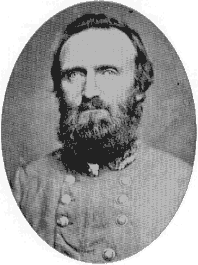
Jackson named the smaller horse "Fancy," still planning to give it as a gift to his wife, and he continued to use that name. However, to officers and men alike, the horse became "Little Sorrel."
Standing only 15 hands high, the 11-year-old horse had a compact body and sturdy legs. He also had a streak of endurance, which would be evident later. By contemporary standards, he was not a pretty animal, but Morgans were known for agility and short bursts of speed.
Little Sorrel was Jackson's favorite from among four horses that acrried him over hundreds of miles and through numerous battles up and down the Shenandoah valley. When Jackson was mortally wounded by troops from the 18th North Carolina Infantry at Chancellorsville, Little Sorrel was spooked momentarily, almost unseating the wounded general as the terrified horse ran through underbrush until he was finally halted. He was captured briefly by Union troops and retaken by the Confederates the next day. The saga repeated until Little Sorrel graciously was allowed to return to the Confederacy permanently.
After Jackson's funeral in 1863, Little Sorrel went first to Lincoln County, N.C., with Mary Anna Morrison Jackson, the general's widow, for whom the horse had been originally intended. When Mrs. Jackson's dwindling finances made upkeep no longer possible, Jackson's mount came to the green fields of VMI for the first time, greeted by crowds of veterans all along the railroad journey.
The small brown horse with the large heart was a favorite at regional fairs as well as at Confederate veterans' reunions. One such appearance was at a Hagerstown, Md., fair in 1884, when former Jackson staff officer Henry Kyd Douglas presented Little Sorrel to the crowd. An eyewitness reported that Douglas' young nephew, riding a Shetland pony, was leading the older horse slowly down the path. When the band began playing "Dixie," Little Sorrel took off with such a "mettlesome step" that the youngster had a difficult time keeping up.
Eventually, Little Sorrel was sent to the R.E. LeeCamp Soldiers' Home in Richmond. Now 36, Jackson's warhorse spent his last years surrounded by the old veterans who revered him. With Little Sorrel in such poor health that he could not stand, a sling or girdle was rigged so the Morgan could be hoisted to his feet for visitors. One day the sling slipped, and the old horse fell, breaking his back. Little Sorrel died soon thereafter, on March 16, 1886.
Though the warhorse had served ably during his lifetime, his "service" was not to end with his death. He would continue as a museum piece.
At the time, standard taxidermy practice was to use the bones and ligaments of an animal. However, in large animals such as a horse, skin deterioration ensued. The technician in charge was Frederic S. Webster, with a studio on Pennsylvania Avenue in Washington. Webster had previously been employed at "Prof. Henry A. Ward's Scientific Establishment" in Rochester, N.Y., and had participated in the mounting of both Gen. Robert E. Lee's famous horse, Traveller, and the horse of Gen. Philip H. Sheridan
For Little Sorrel, the taxidermist decided to use only the hide. Webster had arrived in Richmond the night before Little Sorrel's death and was able to take necessary measurements. Then Webster quickly removed the skin and skeleton. His own words indicate that it was "undertaken because of the record of having carried the famous and beloved General through the heat and blast of a desperate war."
On May 13, 1886, the Lexington Gazette and Citizen reported on the project: "A letter from Professor F.S. Webster, of Washington, D.C. [states] the work on Old Sorrel is moving along slowly, but surely." the taxidermist was quoted as saying that he intended, "all things favoring, to make a perfect piece of workmanship and to do this, vast amount of time and labor is involved."
The final product became one of only two done by this particular method, tanned hide stretched over a plaster framework, and was completed in time to be on exhibit in Webster's Pennsylvania Avenue studio during a meeting of the Grand Army of the Republic in the fall. Members of the Union veterans group visited the studio to see the famous horse of their former adversary as they retold incidents of the war.
For some reason, Webster was allowed to retain the skeleton as partial payment for his services, and in 1903, the bones, now mounted into an articulated skeleton, were given to the Carnegie Institute in Pittsburgh. But many Southerners never accepted the idea that even a portion of the famous horse was displayed in the North, and plans began to return Little Sorrel's bones to Virginia.

It was not until August 1949 that the skeleton came to VMI, first on indefinite loan and then as an outright gift. The VMI director at that time, Wallace Richards, accepted the skeleton with these words: "Stonewall Jackson lived, taught, fought, died, and is buried in the South. Most of his effects and relics are kept near his tomb, at the Virginia Military Institute. As far as the Carnegie Museum is concerned, there is no question of the skeleton's value. It is a symbol of a vital period in this country's struggle and growth. For this very reason, approval has been given to transfer it to an institution where it may be exhibited with other important relics of the period, and where its emotional appeal is most personal and direct."
The stuffed hide of Little Sorrel initially had been displayed at the R.E. Lee Camp home, from which the UDC's Virginia Division inherited it in 1935. When Virginia ceased state funding to the Lee Camp in 1949 after the death of the last surviving veteran and the home was closed, the UDC presented it to VMI's museum.
That it was a popular attraction with both tourists and cadets alike was a mixed blessing. It became a tradition for cadets to pull a hair from Little Sorrel's mane or tail before exams or to rub the flank and withers "for luck."
Soon, the hide became threadbare, and various restorative measures were taken. A Plexiglas partial enclosure affords only minimal protection, and unless the cadets of VMI become more concerned with preservation and less with luck, the scant remains of Little Sorrel on display will no longer be any part of the real animal.
Mrs. Mark R. Allen, president of the Virginia Division of the United Daughters of the Confederacy, considers the burial of the bones and the placement of a grave marker a suitable final chapter to the saga of Little Sorrel. "When I learned only recently that his skeleton had never been buried," she said, "it seemed fitting to ask VMI to allow us the privilege of interring the bones and marking the grave, just as we had marked Traveller's grave several years ago."
She adds: "I know it must seem a bit strange to some people to make such a fuss over a horse, but Southerners are a very devoted people and believe in honoring heroes of all types. It's quite thrilling -- and an honor -- to be able to do this, particularly so many years after the fact. It connects us in a very real way to our past."
The interment site will be next to Jackson's [statue], reuniting soldier and horse for all time.
Martha Boltz is a horse lover from Kentucky and a writer in Northern Virginia.